
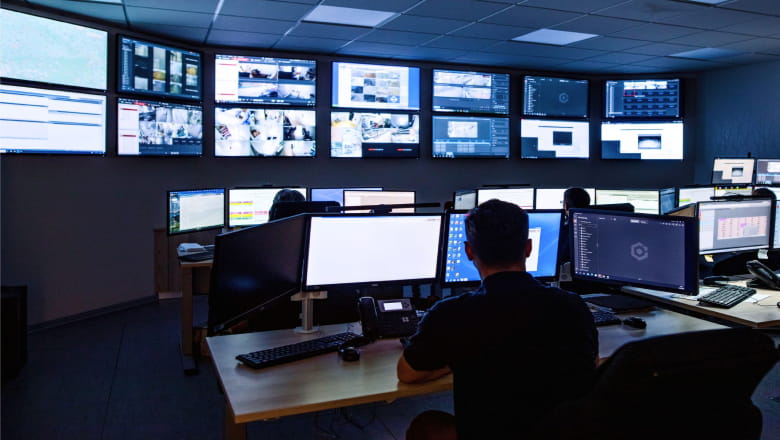
“Technological fortress”
– G4S’s Monitoring and Alarm Receiving Centre in the Czech Republic
Steel-plated walls, two-factor authentication for entry and a backup server are just some the features which enable the centre to operate continuously, no matter what situation might occur.
13 Apr 2026
“Our walls are reinforced with steel plating and we have our own dedicated ventilation system. If there’s a total blackout or a long-term grid failure, we’ll continue to operate without a single second of downtime thanks to a multi-layered backup system.”
“Even emergency food and water supplies are on-site so we can stay operational, no matter what happens in the outside world.”
Pavel Franko, Managing Director for G4S Czech Republic, could be describing an end-of-the world bunker but it is in fact G4S Czech Republic’s Monitoring and Alarm Receiving Centre in Prague – one of only three such facilities in the country which has ČSN EN 50518:2020 certification.
“It’s a seal of the highest quality in the security monitoring industry. Customers know that they aren't just relying on a group of people in a room with monitors, but on a technological fortress that functions even in extreme situations,” Pavel explains.
“Active risk management is the centre’s purpose: we minimise response times, consolidate oversight for clients with multiple sites and augment their security officers on the ground.”
“We can remotely open supply gates or verify access authorisation via an intercom. If we receive a fire or security alarm alert, we can dispatch a response team or contact the emergency services,” Pavel continues.
“And with AI analytics embedded into our video monitoring, operators are immediately alerted to movement in a restricted zone or when a suspicious object is suspected. They will assess the situation and decide if an intervention is necessary or if it’s a false alarm.”
“Even emergency food and water supplies are on-site so we can stay operational, no matter what happens in the outside world.”
Pavel Franko, Managing Director for G4S Czech Republic, could be describing an end-of-the world bunker but it is in fact G4S Czech Republic’s Monitoring and Alarm Receiving Centre in Prague – one of only three such facilities in the country which has ČSN EN 50518:2020 certification.
“It’s a seal of the highest quality in the security monitoring industry. Customers know that they aren't just relying on a group of people in a room with monitors, but on a technological fortress that functions even in extreme situations,” Pavel explains.
Monitoring for 5000 sites
Here, G4S carries out remote monitoring and analysis for over 5000 sites on a 24/7 basis. Remote access and alarm system management are other key capabilities.“Active risk management is the centre’s purpose: we minimise response times, consolidate oversight for clients with multiple sites and augment their security officers on the ground.”
“We can remotely open supply gates or verify access authorisation via an intercom. If we receive a fire or security alarm alert, we can dispatch a response team or contact the emergency services,” Pavel continues.
“And with AI analytics embedded into our video monitoring, operators are immediately alerted to movement in a restricted zone or when a suspicious object is suspected. They will assess the situation and decide if an intervention is necessary or if it’s a false alarm.”
Unique structure
The certification confirms that the building's construction, alarm systems, power supply, and management processes are professionally secured – and staff meet strict professional criteria. Audits are undertaken to ensure these rigorous technical requirements are maintained.
Specifically, the walls and doors must withstand forced entry attempts, gunshots, or explosions. There is a two-stage entry verification to ensure no unauthorized person can enter and advanced fire suppression systems that won't damage any electronics.
Continuity of technology services is fundamental and a standard outage must not take the centre offline. As well as having backup power, there is also a backup server and two independent data paths to ensure an alarm doesn't disappear into a "black hole" if a cable is accidentally cut on the street, for example.
Cybersecurity and data protection are key considerations too. All communications between client sites and the monitoring centre is encrypted, and strict controls are in place to limit access to camera footage and sensitive data. Monitoring systems are separated from the standard internet to minimize hacking risks.
Specialised drills for staff
Staff have to meet strict professional criteria and a minimum number are on shift at all times. They undergo a rigorous onboarding process and comprehensive initial training which covers internal systems, emergency protocols and client-specific requirements.
Standardised procedures are embedded into operations; there is no improvisation, just a fast and precise response. Regular refresher courses and specialized drills ensure continuous development and prepares staff for any situation, no matter how complex.
“A lot of our clients are banks which have some of the most rigorous security requirements in the world. The monitoring centre is specifically designed to meet and exceed their demands – we are the only reliable partner for those who can’t compromise in security.”