
Meet Senya Augustino, Deputy Team Leader for G4S’s Ordnance Management business in South Sudan
An exception to the rule
Senya Jane Augustino is an exception to the rule being a female Deputy Team Leader in the male dominated world of explosive ordnance disposal (EOD), especially in her home country of South Sudan, the world’s youngest country.
After 50 years of civil war, peace came in 2005 followed by Independence on 09 July 2011 allowing Senya to complete her Level 3 International Mine Actions Standards training course that same year. Having worked with several other implementing partners within South Sudan, Senya came to G4S in 2020 as a deminer within the Multi-Tasking Team (MTT) project, a commercial (rather than NGO) demining contract.
Self-sufficient teams
The G4S MTT project comprises four teams tasked by the United Nations Mine Action Service (UNMAS) to clear unexploded ordnance within South Sudan.
These teams are self-sufficient, each with six vehicles (including two ambulances), generators and satellite communications, 12 deminers, 2 mechanics, 2 medics and 2 community liaison officers. The composition of team allows it to be split, giving UNMAS greater flexibility clearing more locations of ordnance throughout the country.
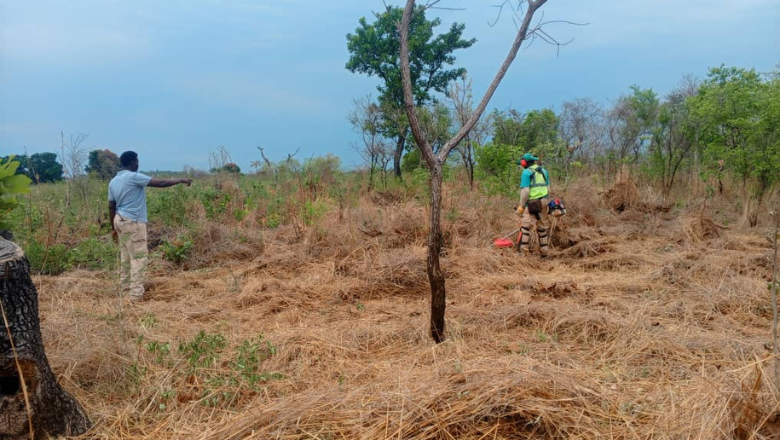
Undertaking EOD clearance work in South Sudan is not without its challenges as Senya acknowledges. The environmental conditions are extreme; the unrelenting African heat, wearing heavy protective equipment and constantly looking for snakes, scorpions and anything else trying to bite or sting. All while searching for unexploded ordnance. It is not everyone’s dream job. For Senya, unexploded ordnance, snakes and scorpions are the norm in her “MTT outdoor office”.
A flair for planning and managing
From the start, Senya made a great impression within G4S and the MTT project, showing a flair for planning and managing small teams. Taking on additional responsibilities, she was promoted to the position of Deputy Team Leader when G4S successfully won the MTT contract again in 2023.
Her G4S Project Management team in Juba gave her the training and support required to be successful and the confidence to manage a team. Within commercial demining, this is a major career advance, within South Sudan and its patriarchal culture, it is very rare for a woman to command-and-control men and almost unheard of in a commercial demining project.
As Senya explains: “I had some schooling, I can read and write, but didn’t think I would be doing daily reports like now. I manage half an MTT team of five male deminers, one community liaison officer, three drivers and a medic, and I have to use a laptop computer! And I manage the team in the field searching for ordnance.”
Clearance is physically and mentally draining
Unexploded ordnance contamination across South Sudan is rife, an indication of the ferocity of the 50 years of fighting between the Sudanese Armed Forces and the Sudan People’s Liberation Army fighting for their independence. Clearance is slow, meticulous, physically and mentally challenging. Few items of unexploded ordnance remain on the surface; those that do, have often been exposed by migrating soils, receding flood waters or found by farmers working the fields and placed to one side.
It is the buried ordnance contamination that must be located, excavated and destroyed such as sub-munitions, anti-personnel and anti-vehicle mines. This is exceptionally dangerous work as the ordnance being excavated is in an unknown condition, possibly having become more sensitive baking in the ground. It may just be a carcass of an empty item of ordnance or even just scrap metal. Only by excavating, can it be assessed as safe to be moved and taken for disposal. Or, if deemed unsafe, destroyed where it’s found. It is Senya’s job to make that decision.
Learning new skills
Her promotion came with a sharp learning curve, it’s not just using a computer or tasking deminers. She had to learn new skills, how to use certain software applications, account for the team’s equipment and write reports. There are also the soft management skills that can only be learnt from experience; dealing with a compassionate case or resolving a dispute with a landowner.
Senya added: “No day is ever the same, even on rest days there are things to do and problems to solve, it’s not all about clearance.”
“Our work is very challenging looking for the explosive remnants of war, but we also have to be aware of thieves who might try to rob from our control point or be stopped by locals drunk on homemade palm wine demanding money.”
Optimism and progress
Senya sees through these minor obstacles and is optimistic about development and progress. “Everyone forgets about South Sudan; we had to fight for 50 years [for our] independence. We need to farm the land and rebuild our country.”
Sadly as Senya acknowledges, “it’s the most vulnerable in South Sudan who suffer, the women and children from working in the fields, collecting wood to make charcoal or for cooking or collecting water from the rivers”.
Although the team uses community liaison officers who tirelessly visit communities and deliver Explosive Ordnance Risk Education and gather information, its women and children who suffer and are injured.
Regardless of the problem solving, the rewards for Senya and her family are transformative. Her husband who lives in Juba, the capital of South Sudan is a pastor administering to those within his parish. “I also have five children, the eldest being 14. I really miss them, but my G4S salary supports their schooling in Uganda. It’s important I give them a [good education]. Education is the way forward to make South Sudan a great African country!”
Careers at G4S
At G4S, you are assured a world of opportunities. Our employees and services touch the lives of others every day.